

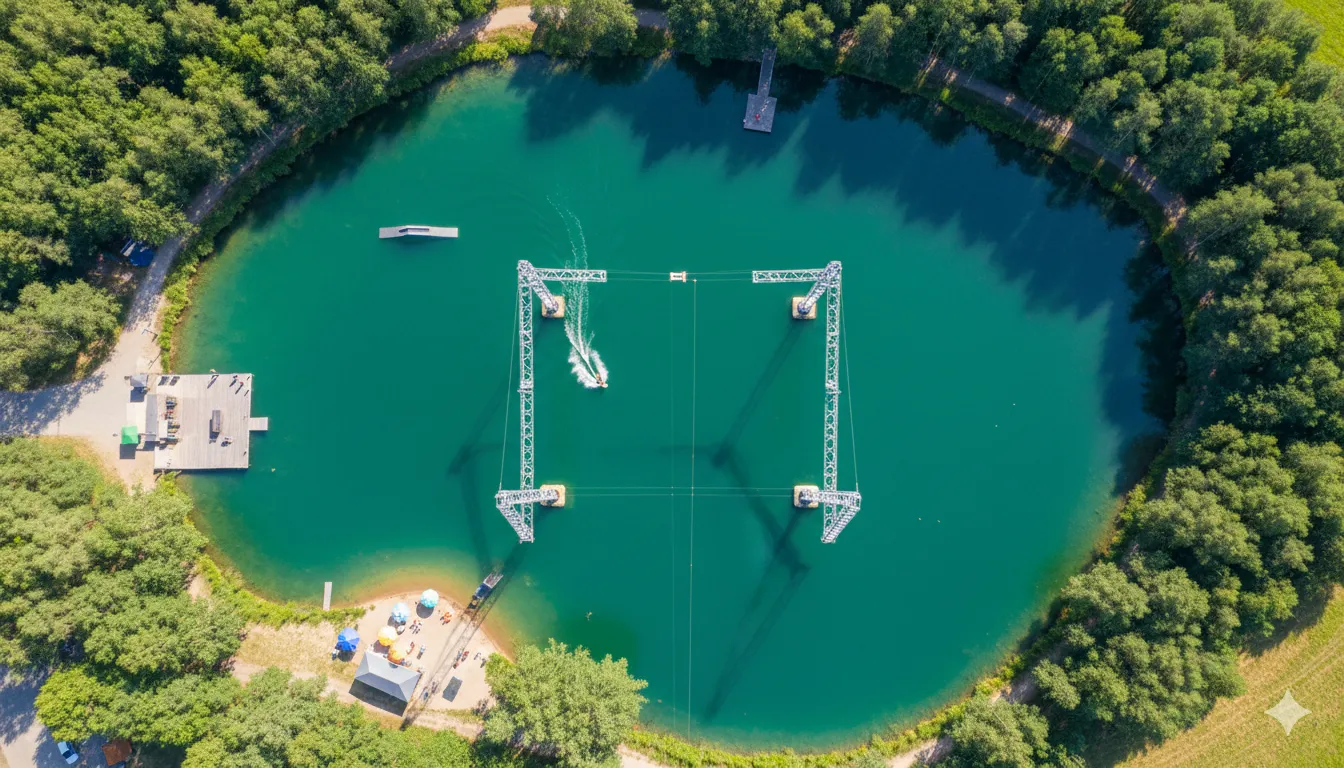
How to Plan a Cable Wake Park: Site Requirements, Installation, and ROI
Starting a cable wake park requires a suitable water body of at least 0.5 hectares, a 3-phase power connection, and local permits. A two-tower system can be operational within 6 weeks from order confirmation — covering production, delivery, and a 2-day on-site installation. Before you invest, this guide walks you through every decision point: site assessment, system selection, permits, installation, and realistic return on investment.
Step 1 — Site Assessment: What to Check Before You Commit
The most expensive mistake in a cable park project is discovering a site problem after equipment is ordered. Knowing how to start a cable wake park correctly means doing thorough site due diligence first. Here are the four non-negotiables.
Water Body Size
A 2-tower WakeStation system requires a minimum footprint of approximately 30 m × 183 m — around 0.57 hectares of open water. A full-size cable park scales up to roughly 150 m × 335 m (5.1 hectares). Measure the usable area, not the total lake. Shoreline obstacles, swimming zones, and navigation corridors all reduce your operational envelope. These are the core cable park site requirements that determine whether a location is viable at all.
Water Depth
Typical operating depth for cable wakeboarding is 1.5–2.1 m. Shallower water is not a safety buffer — it is an injury risk. Critically, the anchor point zones at each tower base must meet minimum depth requirements. A site that looks deep enough in the centre can still fail at the edges. Commission a full depth survey before signing any purchase agreement.
Power Supply
WakeStation systems run on 3-phase 400 V / 50 Hz with a 25 A connection. Operational draw is 32–45 kW depending on load and features in use. If your site lacks grid access, the cost of extending a medium-voltage line or installing generator infrastructure can easily exceed the equipment budget. Confirm grid proximity and transformer capacity with the local utility before committing to the site.
Access Road
Installation requires equipment delivery — anchors, towers, drive units, ropes, and features. The site must be reachable by standard freight vehicles. A remote lake with no road access means added logistics cost and delays. Assess the route, bridge load limits, and turning radius for a flatbed truck before considering the site viable.
Step 2 — Choose Your System
The right system depends on your water body, target market, and budget. WakeStation offers both configurations. Here is a direct comparison to help you decide.
| 2-Tower System | Full-Size System | |
|---|---|---|
| Water footprint | ~30 m × 183 m (0.57 ha) | ~150 m × 335 m (5.1 ha) |
| Equipment investment | $35K–$80K | ~$70K–$100K+ |
| Rider capacity | Lower — suits smaller venues | Higher — suits resort volumes |
| Installation time | 2 working days | 2–4 working days |
| Portability | Portable — seasonal relocation possible | Permanent installation |
| Market catchment needed | Smaller population within 30-min drive | Larger urban or resort market |
| Operating temperature | -15°C to +45°C | -15°C to +45°C |
For investors testing a new market, the 2-tower system offers the lowest entry point and the flexibility to relocate if the first site underperforms. Resort developers or entrepreneurs targeting a high-volume summer destination will typically justify the full-size build from day one. See full technical specifications on the WakeStation system page.
Step 3 — Permits and Planning
Understanding how to start a cable wake park on paper is only half the work — permits are where projects stall. The regulatory timeline varies more than almost any other variable in this business.
Typical permit categories you will need to address:
- Zoning and land use — the site must be classified for commercial recreation or have a variance. Agricultural or conservation-designated land is a common blocker.
- Water use permit — most jurisdictions require a permit to operate mechanical equipment on a water body. Applications typically involve noise assessments, safety exclusion zones, and environmental impact statements.
- Environmental review — sediment disturbance from anchoring, impact on aquatic habitat, and riparian buffer requirements vary widely by country and region.
- Building permit — if your project includes a dock, timing tower, or permanent shore structures, a standard construction permit applies.
Realistic timelines: Straightforward cases in jurisdictions with existing cable park precedent can move through in 2–4 weeks. Complex cases involving environmental objections, public comment periods, or first-of-kind applications can take 6–8 months. Start the permit process before ordering equipment — not after.
WakeStation has supported 107+ installations across 20 countries. Our team can advise on the documentation package that regulators typically request and connect you with operators who have navigated similar permit environments.
Step 4 — Wake Park Installation Timeline
One of the strongest arguments for a WakeStation system is speed to revenue. Here is a realistic week-by-week schedule from confirmed order to opening day.
- Weeks 1–4: Production. Components are manufactured and quality-checked at the WakeStation facility. Custom features, if ordered, are fabricated in parallel.
- Week 5: Shipping and logistics. Freight transit times depend on destination — most European and North American sites receive equipment within this window.
- Week 6, Days 1–2: On-site installation. A WakeStation crew completes anchor placement, tower erection, rope rigging, drive unit commissioning, and operator handover training in 2 working days.
Total: approximately 6 weeks from confirmed order to first rider.
This assumes site preparation — anchor zones cleared, power connected, access road ready — is completed before the installation crew arrives. Delays in site prep are the most common reason actual opening slips past the 6-week mark. Explore the full feature set available for your build on the WakeStation features page.
Common Mistakes That Kill Cable Park Projects
After supporting more than 107 installations across 20 countries, we have seen the same avoidable errors surface repeatedly. A solid cable park business plan accounts for all of these before capital is committed.
Too Shallow at the Anchor Points
Operators measure depth in the riding lane and assume the anchor zones are fine. They are often not. Anchor installation in insufficient depth requires expensive dredging or forces a redesign of the cable geometry. Survey the full footprint, not just the riding corridor.
No Grid Access
A site that is beautiful but far from infrastructure is a budget trap. Extending a medium-voltage line to a remote lake can cost as much as the cable system itself. Always get a utility quote before acquiring land or signing a lease.
Wrong Zoning Classification
Zoning variances are possible but not guaranteed, and they add months to the timeline. Sites already classified for recreation or water sports dramatically reduce permit risk. This is one of the cable park site requirements that is easy to overlook when the water itself looks perfect.
Underestimating Feature Costs
The cable system is the foundation, not the finished product. Riders return for obstacles — kickers, rails, sliders, and air ramps. A well-designed feature set for opening day adds meaningfully to the project budget. Plan the full riding experience, not just the cable, from the start. Browse the Pentasi FSC obstacle range for reference.
Is a Cable Wake Park Profitable?
Understanding how to start a cable wake park also means understanding the business model clearly. Here is what realistic financial planning looks like.
Revenue Drivers
The primary revenue stream is session tickets. A healthy park targets 100+ riders per day across a 165-day operating season — approximately May through September in Northern Europe and North America. Secondary revenue streams that meaningfully improve unit economics include:
- Lessons and coaching — higher margin than general sessions, builds a returning rider base
- Equipment rental — boards, wetsuits, and helmets for walk-in customers
- Events and private hire — corporate team days, competitions, and birthday packages fill off-peak slots
- Food and beverage — even a simple kiosk meaningfully improves per-visitor revenue
Break-Even Horizon
For a 2-tower installation at the lower end of the equipment range, operators who consistently hit their daily rider targets typically reach break-even within approximately 3 years. Higher equipment investment, lower seasonal traffic, or significant site development costs extend that timeline. Build a conservative model — use 70% of your target daily rider count as your base planning case.
Catchment Population
The 30-minute drive radius is the practical market for a wake park. A site within that radius of a town or city of 50,000+ people has a viable walk-in audience. Smaller catchment areas can still work — particularly in established watersports destinations or holiday resort locations — but the business model becomes more dependent on overnight visitors and marketing investment.
Frequently Asked Questions
What is the minimum lake size for a cable wake park?
A 2-tower WakeStation system requires approximately 30 m × 183 m of open water — around 0.57 hectares. This is the minimum footprint for a functional commercial setup. The full-size system requires approximately 5.1 hectares of usable water. In both cases, the area must be measured after excluding hazard zones, swimming areas, and navigation corridors.
How long does cable wake park installation take?
WakeStation completes on-site installation in 2 working days. Including 4 weeks of production time and shipping, the full wake park installation timeline from confirmed order to opening day is approximately 6 weeks. Site preparation — power connection, access road, anchor zone clearing — must be completed before the installation crew arrives to keep to this schedule.
What permits do I need for a cable park?
Requirements vary by jurisdiction, but most projects need a water use permit, a zoning or land use approval, and an environmental review. Some jurisdictions also require a commercial recreation operating licence and proof of public liability insurance before opening. Engage a local planning consultant early — permit timelines range from 2 weeks to 8 months depending on local regulation and whether cable parks have been approved in that area before.
Can a cable wake park operate in cold climates?
Yes. WakeStation systems are rated for operating temperatures from -15°C to +45°C. Parks in Scandinavia, Canada, and Central Europe can open as soon as ice clears in spring and run through autumn. The 2-tower system is also portable, allowing seasonal relocation between sites if your primary location has a short operating season.
Ready to Start Planning Your Cable Wake Park?
WakeStation has helped investors, resort developers, and entrepreneurs open cable parks on five continents. Whether you are at the site selection stage or ready to place an order, our team can walk you through the full process — from the first feasibility call to opening day.