

What Business Can You Start on a Lake? A Practical Guide for Landowners (2026)
The five most viable lake businesses for waterfront landowners are kayak and SUP rental, fishing charters, glamping, jet-ski rental, and cable wake parks. Of these, a cable wake park offers the strongest combination of revenue potential, local market exclusivity, and return on investment — with two-tower systems starting at $35,000–$80,000 and no boat or large staff required to operate.
You own waterfront property — a lake, a pond, a stretch of river. You know it’s worth something beyond the view. Waterfront homes sell for 25–50% more than comparable inland properties, but the land itself could generate far more as an operating business than as a passive asset.
The adventure tourism market is valued at over $350 billion globally and growing at 16–18% per year. Outdoor recreation participation in the US hit a record 181 million people in 2024. The demand is real and rising — the question is which business model makes the most sense for your specific property.
This guide compares five proven waterfront business models side by side. We break down the real startup costs, revenue potential, risks, and return timelines — so you can make a decision based on numbers, not guesswork.
Quick Comparison: 5 Lake Business Models at a Glance
| Kayak & SUP Rental | Fishing Charters | Glamping | Jet-Ski Rental | Cable Wake Park | |
|---|---|---|---|---|---|
| Startup Cost | $20K–$100K | $80K–$200K | $270K–$750K | $25K–$295K | $35K–$100K (2-tower) |
| Annual Revenue | $50K–$200K | $35K–$500K | $90K–$180K | $60K–$360K | $200K–$1.2M |
| Net Margin | 20–40% | ~25% | 35–47% | 20–40% | 25–30% |
| Payback Period | 1–2 seasons | 2–5 years | 2–4 years | 1–3 seasons | 2–3 years |
| Local Competition | High | Medium | Growing | Medium | Near zero |
| Staff Needed | 1–2 | 1 (captain) | 1–3 | 2–3 | 1–2 |
| Regulation Burden | Low | Medium | High | Very high | Medium |
1. Kayak & SUP Rental — Low Barrier, Low Ceiling
Kayak and paddleboard rentals are the most common first business for lake property owners. The appeal is obvious: buy a dozen kayaks, set up a rack by the water, and start renting at $25–$50 per hour. Startup costs can be as low as $20,000 for a basic fleet of 5–10 units with life vests and a booking system.
The problem is that everyone else has the same idea. The US kayak rental market is estimated at around $500 million, and the barrier to entry is so low that competition is fierce at any popular lake. Your neighbor can undercut you with a Craigslist fleet and a handwritten sign.
Revenue for a small seasonal operation typically lands between $50,000 and $200,000 per year — enough to supplement income, rarely enough to replace it. The biggest risk is scaling too fast: one operator invested in a 25-foot trailer loaded with 12 SUPs, only to close within two years when demand didn’t match the investment.
Best for: Landowners who want a low-risk side income and don’t mind competing on price. Not a destination business — nobody drives two hours to rent a kayak.
2. Fishing Charters & Guided Tours — Expertise-Dependent
Fishing charters can be profitable, but the business lives or dies on the captain’s reputation and ability to put clients on fish consistently. Startup costs are significant: a serviceable charter boat runs $30,000–$100,000, plus you’ll need a USCG Captain’s License (~$850 for a Six-Pack OUPV), insurance, tackle, and marketing.
A solo captain in a good market earns $35,000–$55,000 in annual profit. Top operations in high-demand tourist areas can reach $500,000 in revenue, but that’s the exception. Half-day private charters typically charge $300–$900, and full-day trips go for $600–$2,000 — but you’re limited by how many days you can safely run per season.
In northern climates, that season is 4–5 months. Income is heavily compressed into 90–120 days, and one bad weather week can wipe out a significant portion of annual revenue. The business also requires constant reinvestment — engine rebuilds, fuel costs, and boat maintenance eat into margins relentlessly.
Best for: Experienced anglers with local knowledge who enjoy being on the water daily. Not suitable for passive or absentee ownership.
3. Glamping & Lakeside Cabins — High Investment, Slow Return
Glamping is a strong trend — the global market reached $3.6 billion in 2024 and is growing at 10–14% annually. Average nightly rates in the US hit $251 in 2025, up 21% from $207 in 2023. The economics look attractive on paper.
The reality is more complex. Building a 5-unit glamping site with proper infrastructure (septic, electric, water, access roads) costs $270,000–$750,000. At 60% occupancy and $180 per night, a 5-unit site generates roughly $137,000 per year — attractive, but payback takes 2–4 years even in the best case.
The biggest obstacle isn’t money — it’s zoning. “Glamping” doesn’t exist as a permitted use in any US zoning code. You’ll need to file under “campground” or “retreat center,” which often requires a conditional use permit, septic system design approval, ADA compliance, and fire marshal sign-off. Many projects die at the permitting stage before a single tent goes up.
Seasonal occupancy swings are brutal: typically strong in summer, but dropping sharply in winter months. That means six months of strong revenue subsidizing six months of overhead.
Best for: Landowners with capital, patience, and properties in high-demand tourist areas. Works best when combined with an anchor attraction that drives visitors year-round.
4. Jet-Ski Rental — High Revenue, Higher Risk
Jet-ski rental is one of the highest-grossing hourly rental businesses on water. At $75–$150 per hour, a fleet of 6 jet-skis can generate $30,000+ per month during peak season. A new Sea-Doo Spark starts at around $7,000–$8,700 depending on model year, making the equipment investment seem manageable.
But jet-skis come with serious complications. They’re involved in roughly 20% of all vessel accidents despite representing only about 12% of registered watercraft. Commercial insurance costs $2,000–$20,000+ per year depending on fleet size and location. Maintenance runs $1,000–$1,500 per unit annually, plus $850–$1,100 for winterization. A jet-ski loses roughly 44% of its value in five years — your fleet is a depreciating asset.
The regulatory landscape is the biggest wildcard. Jet-skis can reach up to 115 decibels at peak output and face restrictions on many lakes. Lake Tahoe, Lake Mead, and Lake Powell prohibit older two-stroke PWC engines, while modern four-stroke models are permitted. Personal watercraft are banned entirely in 11 national parks, though 21+ national recreation areas allow them. Maine and Vermont have state-level restrictions, and many local jurisdictions have their own ordinances. Before investing a dollar, you need to verify that PWC (personal watercraft) operation is legal on your specific body of water.
Best for: High-traffic tourist lakes where PWC is explicitly permitted, and where you can tolerate the insurance and liability burden. Check regulations first — many landowners discover too late that their lake has PWC restrictions.
5. Cable Wake Park — The Business Nobody’s Talking About
Here’s what’s remarkable: we reviewed every major “lake business ideas” article online — lists of 12, 50, even 60 ideas — and not a single one mentions cable wake parks. Yet over 1,100 cable systems operate worldwide, the cable wakeboarding market is estimated at $695 million, and participation in wakeboarding grew 18% between 2019 and 2024.
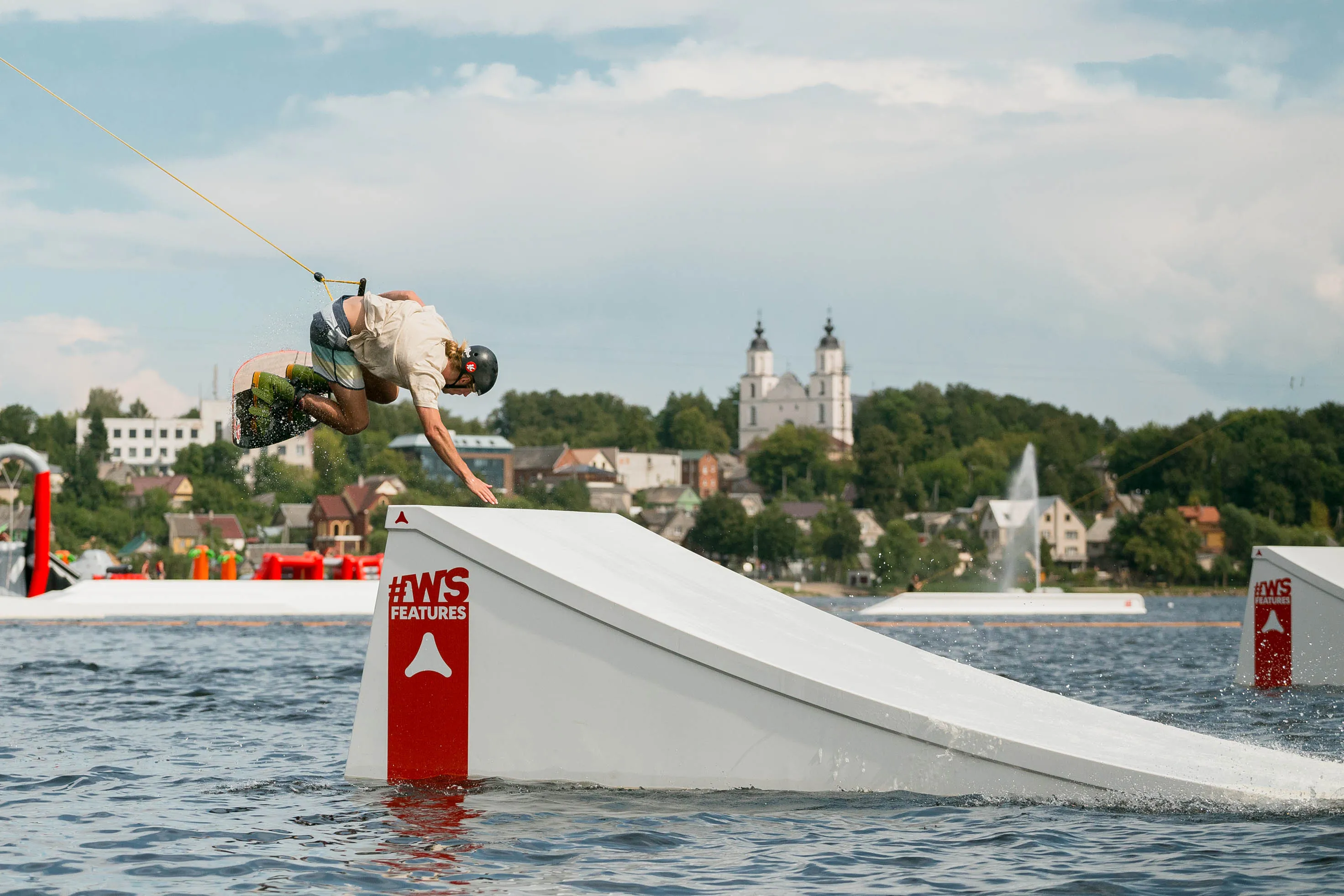
A cable wake park uses an overhead cable system to pull riders across the water — no boat needed. A two-tower system requires as little as 100–300 meters of straight water and can serve 50+ riders per day with just 1–2 operators. Unlike a boat-based operation, there’s no fuel cost, no captain’s license, and no depreciation on a $100,000 vessel.
The economics
A compact two-tower cable system — the entry point for most new parks — costs $35,000–$80,000 for the equipment, with total all-in setup running $50,000–$100,000 including site preparation and electrical connection. Full-size 5–6 tower parks start at $300,000+ for the cable system alone.
Session pricing at established cable parks runs $42–$50 for a two-hour block, with day passes at $60–$90 and season passes at $750–$1,000. The primary operating cost is electricity — which can represent a significant share of total operating expenses — which is predictable and far cheaper than the fuel, maintenance, and depreciation costs of boat-based businesses.
Why the numbers work differently
The fundamental advantage of a cable wake park is that you’re not trading hours for dollars the way a fishing charter or kayak rental does. Once the system is installed, it pulls riders continuously. One operator can manage the entire session. There’s no per-trip fuel cost, no per-customer equipment degradation at the rate jet-skis experience, and no seasonal restocking.
Established full-size cable parks generate $1.2 million+ in annual revenue according to industry financial models, with an EBITDA of roughly $318,000 in Year 1 and a payback period of approximately 44 months. For a compact two-tower system with proportionally lower investment, the math works even faster.
The competitive moat
This is where cable wake parks differ from every other business on this list. At any popular lake, there are already kayak rentals, fishing charters, and probably glamping options. But cable wake parks remain relatively uncommon — around 1,100 systems worldwide, with Germany’s approximately 100 parks being the densest market.
If you install a cable wake park, you almost certainly become the only one within a wide radius. That means no price competition, no race to the bottom, and a genuine reason for people to drive to your location specifically. You’re not just another rental — you’re a destination.
Cable wakeboarding is also increasingly recognized as a competitive sport. The 2024 IWWF World Cable Wakeboard Championships were held in Paris, and qualifying criteria for The World Games 2025 included cable wake events. That trajectory brings mainstream visibility and new participants to every park in the network.
Winter potential
Unlike every other business on this list, a cable system can operate year-round in climates with snow. The same cable that pulls wakeboarders across water in summer can pull snowboarders across a snow-covered field or frozen lake in winter. That turns a seasonal business into a year-round operation — a transformation no kayak, jet-ski, or fishing charter can match.
Best for: Landowners who want a destination business with strong margins, minimal competition, and a genuine competitive moat. Especially powerful when combined with complementary offerings like glamping, food service, or event hosting — creating a complete lakeside destination rather than a single-activity rental.
How to Choose the Right Business for Your Waterfront
The right business depends on three factors: your water, your budget, and your ambition.
If your water is small (pond, narrow creek): Kayak and SUP rental is your realistic option. Cable systems need at least 100 meters of straight water.
If you want minimal investment and quick cash flow: Kayak rental or fishing charters get revenue flowing fastest, but ceiling is low.
If you want to build a destination: A cable wake park creates the anchor attraction, and you can add glamping, food service, and events around it over time. This is the model that generates the highest long-term value from waterfront property. Start with our planning guide.
If you have significant capital and a tourist-heavy location: Glamping delivers strong passive income once permitted and built, but expect a longer path to opening day.
Regardless of which model you choose: Check local zoning, water use permits, and environmental regulations before investing. Every lake has different rules, and some of the most profitable-sounding options (particularly jet-skis) may be prohibited on your specific body of water.
Frequently Asked Questions
What is the most profitable business to start on a lake?
Based on revenue-to-investment ratio, a cable wake park offers the highest return potential. A two-tower system starting at $35,000–$80,000 can generate significantly more revenue per dollar invested than kayak rentals or fishing charters. Full-size cable parks generate over $1 million annually. The key advantage is minimal competition — unlike kayak rentals, which exist at every popular lake, cable wake parks remain rare globally.
How much does it cost to start a waterfront business?
Costs range widely by business type. Kayak rental can start at $20,000. Fishing charters require $80,000–$200,000 (mostly for the boat). A compact cable wake park runs $50,000–$100,000 all-in. Glamping sites with proper infrastructure cost $270,000–$750,000 for 5–10 units. Jet-ski rental fleets start at $25,000 but can reach $295,000 for a full commercial operation.
Can you start a cable wake park on a small lake?
Yes. A two-tower cable system needs as little as 100–300 meters of straight, unobstructed water. The system is portable and can be installed on lakes, ponds, rivers, and even artificial lagoons. Many WakeStation systems operate on water bodies that would be too small for a full-size 5–6 tower park, making the two-tower design ideal for private landowners.
What waterfront businesses work year-round?
Most water-based businesses are seasonal. Glamping can operate year-round with heated units, but occupancy drops sharply in winter. Cable wake parks are unique in that the same cable system can pull snowboarders in winter, enabling true year-round operation. Fishing charters and jet-ski rentals are strictly warm-season in northern climates.
Do you need permits for a water sports business?
Yes. Every water-based business requires some combination of zoning approval, water use permits, liability insurance, and operational licenses. Fishing charters require a USCG Captain’s License. Jet-ski rentals face the strictest regulations — personal watercraft are banned entirely in 11 national parks, though 21+ national recreation areas allow them. Glamping faces complex zoning challenges since it’s not a recognized permit category. Cable wake parks typically require a water use permit and standard commercial insurance.
Interested in how a cable wake park could work on your property? See how the two-tower system works or contact us for a site assessment. We’ve installed 100+ systems in 20+ countries since 2011 — chances are, we’ve seen a property like yours before.